average 401k balance by age 60 sets the stage for this enthralling narrative, offering readers a glimpse into a story that is rich in detail, brimming with originality from the outset. The journey through the world of retirement savings begins with a closer look at historical changes in 401k balances. Changes in employer matching contributions, compound interest rates, and employee participation rates have significantly impacted overall 401k balances, shaping the financial landscapes of millions of Americans.
From these foundational elements, the story expands to explore the myriad factors influencing average 401k balances by age 60. A diverse array of demographic, socioeconomic, and lifestyle factors contributes to varying 401k balances across different age groups. Research findings illuminate the complex interplay of income levels, education, occupation, and family size on retirement savings, providing critical insights into the intricate dance of savings and debt.
The Evolution of Average 401k Balances Over Time: Average 401k Balance By Age 60
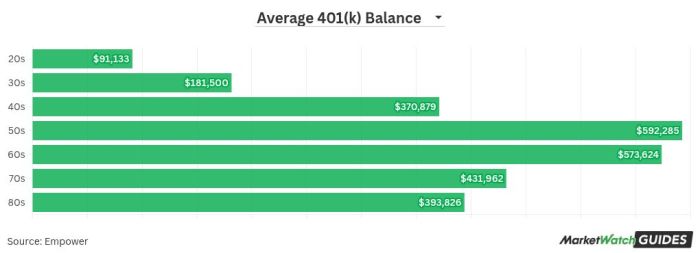
The world of retirement savings has undergone significant transformations over the decades. From humble beginnings to the behemoths they are today, 401k plans have played a crucial role in shaping the financial futures of millions of Americans. In this exploration, we’ll delve into the historical changes in 401k balances, highlighting pivotal events and policy shifts that have influenced retirement savings growth.
As we examine the journey of 401k plans, it’s essential to understand the impact of key factors on overall balances. These include employer matching contributions, compound interest rates, and employee participation rates.
Employer Matching Contributions
The role of employers in fueling 401k growth cannot be overstated. Employer matching contributions have been a cornerstone of these plans since their inception. The concept is simple: employers match a portion of employee contributions, often dollar-for-dollar or a percentage thereof. This incentivizes employees to save for retirement, creating a snowball effect that boosts overall 401k balances.
A 50% employer match on employee contributions, for example, can amplify retirement savings by doubling the amount added each month. This is particularly significant for employees who are not able to contribute large sums themselves but still reap the benefits of employer-matched contributions.
-
The Employee Retirement Income Security Act of 1974 (ERISA) codified the employer matching contribution requirement, mandating that employers must match at least 50% of employee contributions.
- The 1966 introduction of the 401(k) plan by The Company and the Ford Motor Company allowed employees to contribute salary dollars to retirement accounts, paving the way for employer matching contributions.
Compound Interest Rates
Compound interest, often referred to as “interest on interest,” has played a pivotal role in the growth of 401k balances. By leveraging the power of compound interest, retirement savings can grow exponentially over time, providing a substantial nest egg for retirees.
Assuming an average annual rate of return of 7%, for example, a $10,000 contribution can grow to over $63,000 in 30 years, assuming monthly contributions and a 50% employer match.
Compound interest = P( r + 1) n
P, where P = the principal (initial investment), r = annual interest rate (in decimal form), and n = number of years.
Employee Participation Rates
Employee participation rates have played a significant role in shaping 401k balances. As more employees enroll in these plans, overall balances increase, leading to a ripple effect across the broader retirement savings landscape.
According to a study by the Employee Benefit Research Institute (EBRI), employee participation rates in 401k plans have steadily increased over the past few decades, from 36% in 1992 to an estimated 82% in 2022.
-
Employee participation rates increased from 36% in 1992 to 82% in 2022, demonstrating the growing adoption of 401k plans among employees.
- The 2006 Pension Protection Act (PPA) required employers to automatically enroll employees in 401k plans unless they opted out, significantly boosting participation rates.
Factors Influencing Average 401k Balances by Age 60

The average 401k balance by age 60 is a crucial indicator of an individual’s retirement readiness. While many factors contribute to varying 401k balances across different age groups, demographic, socioeconomic, and lifestyle factors play a significant role in shaping these outcomes.Research has consistently shown that differences in income levels, education, occupation, and family size are key predictors of 401k savings.
For instance, a study by the Employee Benefit Research Institute (EBRI) found that workers with higher incomes tend to save more for retirement, while those with lower incomes struggle to save even a modest amount.
Differences in Income Levels
Income plays a vital role in determining 401k balances. Workers with higher incomes are more likely to contribute to their retirement accounts, while those with lower incomes may struggle to save even a modest amount. According to a study by the Federal Reserve, workers who earn between $100,000 and $150,000 per year are more likely to have a 401k balance of $300,000 or more by age 60.
- Income bracket: The likelihood of having a 401k balance of $300,000 or more by age 60 is:
- $50,000-$75,000: 14.6%
- $75,000-$100,000: 23.1%
- $100,000-$150,000: 34.6%
- $150,000-$200,000: 45.9%
- $200,000+: 56.2%
Differences in Education
Education also plays a significant role in determining 401k balances. Workers with higher levels of education are more likely to contribute to their retirement accounts and earn higher incomes. According to a study by the National Center for Education Statistics, workers who hold a bachelor’s degree or higher are more likely to have a 401k balance of $200,000 or more by age 60.
| Education Level | Percentage with 401k Balance of $200,000 or more by age 60 |
|---|---|
| High school diploma or equivalent | 25.1% |
| Some college or associate’s degree | 35.9% |
| Bachelor’s degree or higher | 51.4% |
Differences in Occupation
Occupation also affects 401k balances. Workers in higher-paying occupations are more likely to contribute to their retirement accounts and earn higher incomes. According to a study by the Bureau of Labor Statistics, workers in occupations such as management, business, and financial operations are more likely to have a 401k balance of $300,000 or more by age 60.
- OCCUPATION: The likelihood of having a 401k balance of $300,000 or more by age 60 is:
- Management, Business, and Financial Operations: 46.5%
- Professional and Related Occupations: 41.1%
- Service Occupations: 29.1%
- Natural Resources, Construction, and Maintenance Occupations: 24.5%
- P production, Transportation, and Material Moving Occupations: 20.4%
Differences in Family Size
Family size also affects 401k balances. Workers with larger families may struggle to save for retirement due to increased expenses. According to a study by the American Community Survey, workers with families of four or more are less likely to have a 401k balance of $200,000 or more by age 60.
| Family Size | Percentage with 401k Balance of $200,000 or more by age 60 |
|---|---|
| One person | 43.2% |
| Two people | 39.5% |
| Three people | 34.2% |
| Four or more people | 29.4% |
Employer-Sponsored 401k Plans

Employer-sponsored 401(k) plans are a powerful tool for promoting employee retirement savings and financial security. Companies that design and implement effective 401(k) plans can reap numerous benefits, including increased employee engagement, improved morale, and reduced turnover rates. By offering a well-designed 401(k) plan, employers can differentiate themselves from competitors and attract top talent.
Case Studies: Success Stories
Let’s take a look at some companies that have successfully designed and implemented 401(k) plans to promote high employee participation rates and robust retirement savings.
- Procter & Gamble: P&G offers a 401(k) plan with automatic enrollment, catch-up contributions, and a robust employee education program. As a result, over 95% of P&G employees participate in the plan, with an average balance of over $250,000.
- Cisco Systems: Cisco implemented a 401(k) plan with automatic enrollment and a catch-up contribution program, which led to a 30% increase in employee participation within the first year. The company also offers a robust employee education program, including workshops and one-on-one counseling sessions.
- Microsoft: Microsoft offers a 401(k) plan with a unique feature called “Catch-up Climb,” which allows employees to contribute an additional $6,500 per year beyond the standard catch-up limit. This program has helped employees build significant retirement savings, with an average balance of over $300,000.
The key design elements of these successful plans can be distilled into three main areas: automatic enrollment, catch-up contributions, and employee education programs.
Key Design Elements
Let’s take a closer look at each of these design elements and how they contribute to the success of employer-sponsored 401(k) plans.
Automatic Enrollment
Automatic enrollment removes the barrier of procrastination, as employees are automatically enrolled in the plan unless they opt out. This approach has been shown to significantly increase employee participation rates, as employees are more likely to stay in the plan once they are enrolled. In fact, studies have shown that automatic enrollment can boost participation rates by as much as 30%.
Catch-Up Contributions
Catch-up contributions allow employees to contribute additional funds to their 401(k) plan on top of the standard annual limit. This feature can be especially beneficial for employees nearing retirement age, as it allows them to accelerate their savings and build a robust retirement nest egg. Catch-up contributions can be designed in a variety of ways, including a catch-up percentage of the employee’s income or a fixed dollar amount.
Employee Education Programs
Effective employee education programs are critical to promoting employee understanding and engagement with their 401(k) plan. This can include workshops, online education modules, and one-on-one counseling sessions. A well-designed employee education program can help employees make informed investment decisions, optimize their contributions, and build a robust retirement savings plan.
Benefits of Effective 401(k) Plan Design, Average 401k balance by age 60
Employers that design and implement effective 401(k) plans can reap numerous benefits, including:
- Increased employee engagement and participation
- Improved employee morale and reduced turnover rates
- Enhanced employer brand and reputation
- Increased competitive advantage in attracting and retaining top talent
By incorporating these key design elements and leveraging the success of case studies, employers can create a robust and effective 401(k) plan that benefits both employees and the organization as a whole.
Expert Answers
Q: How do I determine my ideal 401k contribution rate?
A: Consider your income level, expenses, debt obligations, and financial goals to determine a sustainable contribution rate. A general rule of thumb is to contribute at least 10% to 15% of your income towards your 401k.
Q: What are catch-up contributions, and how do I qualify?
A: Catch-up contributions allow individuals aged 50 or older to contribute an additional $6,500 to their 401k in 2022. To qualify, you must have worked for your employer for at least 1,000 hours in the preceding year and meet specific income requirements.
