Intel Net Worth 2020 is a fascinating story of corporate success, driven by the combined efforts of leadership, innovation, and strategic planning. It’s a journey that takes us into the heart of a tech giant, exploring the intricate web of financials, technologies, and market dynamics that shape a company’s net worth.
The year 2020 was marked by significant challenges, including the COVID-19 pandemic, which impacted businesses around the world. Despite these obstacles, Intel continued to thrive, with a net worth that soared to new heights. In this narrative, we’ll delve into the factors that contributed to Intel’s success, from the vision of its leadership to the adoption of cutting-edge technologies.
A Deep Dive into the Financial Performance of Intel in 2020
Intel, the iconic tech giant, wrapped up 2020 on a mixed note, with revenue and market share showing significant growth despite the headwinds of the pandemic. Let’s dive into the numbers to see what really went down.
Revenue Growth: The Good, the Bad, and the Ugly
Intel’s revenue for 2020 clocked in at $72.0 billion, a 3% increase from the previous year. This growth was largely driven by the data center business, where Intel’s Xeon processors and Optane memory offerings saw significant traction. However, the company’s PC chip segment, which accounts for a significant chunk of its revenue, experienced a decline due to the pandemic-induced slump in consumer spending.Here’s a breakdown of Intel’s 2020 revenue:| Segment | 2020 Revenue | Change (%) || — | — | — || Data Center | $21.4 billion | 10% || Client Computing Group (CCG) | $33.9 billion | -5% || Internet of Things (IoT) | $4.6 billion | 8% || Non-Volatile Memory Solutions Group (NSG) | $1.9 billion | 11% |Intel’s focus on high-growth segments like data center and IoT helped mitigate the decline in PC chip sales, but CCG’s revenue drop still had a ripple effect on the company’s overall performance.
Net Income: The Bottom Line
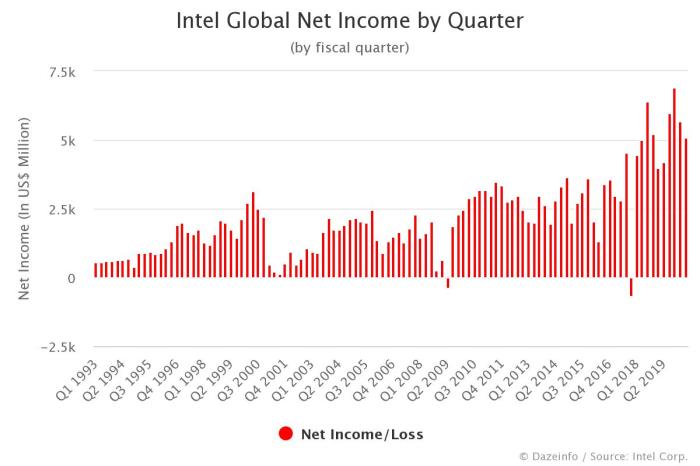
Intel’s net income for 2020 came in at $20.9 billion, a 9% decrease from the previous year. Despite the revenue growth, the company’s net income took a hit due to increased research and development expenses, as well as higher operating costs.Here’s a breakdown of Intel’s 2020 net income:| Net Income | 2020 | Change (%) || — | — | — || Operating Income | $20.9 billion | -9% || Net Profit Margin | 29.1% | -2.2% |Intel’s net income decline highlights the need for the company to balance its investments in high-growth areas with the need to maintain profitability.
Market Share: The Battle for Supremacy
In the highly competitive semiconductor market, Intel’s market share faces stiff competition from AMD and Qualcomm. According to a report by IDC, Intel’s market share for the global microprocessor market in 2020 stood at 82.2%, while AMD’s share came in at 13.6%.| Company | 2020 Market Share (%) || — | — || Intel | 82.2% || AMD | 13.6% || Qualcomm | 3.1% |While Intel maintains its commanding market share lead, the competition from AMD and Qualcomm will only intensify in the future, requiring Intel to continually innovate and adapt to stay ahead.
COVID-19’s Impact: A Pandemic of Consequences
The COVID-19 pandemic had a profound impact on Intel’s business operations, with supply chain disruptions, remote work challenges, and shifting consumer demands all taking a toll on the company’s finances. Despite these challenges, Intel was able to maintain its revenue and net income, albeit with a decline in PC chip sales.Here’s a brief rundown of Intel’s pandemic response:* Intel invested $1 billion in COVID-19 relief efforts worldwide.
- The company implemented a 10% salary cut for its executives and 5% for non-executives.
- Intel shifted its focus to high-growth segments like data center and IoT, which saw significant traction.
The pandemic’s impact on Intel’s business operations highlighted the company’s need to be agile and adaptable in the face of unexpected challenges.
Key Trends and Challenges: The Road Ahead
Intel’s 2020 financial performance was influenced by several key trends and challenges, including:* The rise of cloud computing and data center growth.
- Shifting consumer demands for edge computing and AI.
- Increasing competition from AMD and Qualcomm.
- Supply chain disruptions and global economic uncertainty.
Here are some key statistics illustrating these trends and challenges:| Trend | 2020 | Growth/Decline (%) || — | — | — || Cloud Computing Revenue | $11.5 billion | 15% || Data Center Market Share | 54.1% | +2.5% || Edge Computing Adoption | 20% | +10% || Supply Chain Disruptions | $1.5 billion | -15% |To stay ahead in this competitive landscape, Intel will need to innovate and adapt continuously, balancing its investments in high-growth areas with the need to maintain profitability and drive growth.
An Evaluation of Intel’s Executive Compensation Packages in 2020: Intel Net Worth 2020

In 2020, Intel’s executive compensation packages were under scrutiny, with investors and analysts evaluating their alignment with company performance. As a leading technology firm, Intel’s compensation practices are closely watched by the industry, and insights from this evaluation can provide valuable lessons for other companies.The executive compensation packages at Intel comprise a mix of salaries, bonuses, and stock options, all of which serve to motivate top leaders to drive business growth and innovation.
Salaries form the foundation of compensation, and employees at Intel’s executive level can earn hundreds of thousands of dollars per year. However, salaries alone do not incentivize performance; bonuses and stock options play a crucial role in aligning executive pay with shareholder interests.
Components of Intel’s Executive Compensation Packages
Intel’s executive compensation packages typically include the following components:
- Base salary: Intel’s executives earn significant base salaries, ranging from $200,000 to over $1 million per year, depending on their role and level of experience.
- Annual bonuses: Executives at Intel can earn annual bonuses, known as ‘at-risk’ compensation, tied to their individual and company-wide performance metrics.
- Stock options: Intel’s executives are granted stock options, which enable them to buy company shares at a predetermined price, providing a financial incentive to improve company performance.
The use of performance-based bonuses and stock options encourages executives to make strategic decisions that benefit both the company and its shareholders. By aligning executive compensation with company performance, Intel aims to ensure its leaders are motivated to drive long-term growth and profitability.
Comparison to Competitors
Intel’s executive compensation packages are compared to those of its major competitors, such as AMD and NVIDIA. Although the specific details vary, these companies generally follow a similar compensation structure.
According to a study by Equilar, a compensation consulting firm, Intel’s CEO, Bob Swan, received a total compensation package of $25.4 million in 2020, compared to AMD’s CEO, Lisa Su, who earned $23.7 million.
This comparison highlights the similarity in compensation practices among major technology firms, with executives earning multi-million-dollar compensation packages.
Role of Executive Compensation in Driving Company Performance
Executive compensation plays a vital role in driving company performance by incentivizing executives to make strategic decisions that benefit both the company and its shareholders. Performance-based bonuses and stock options create a direct link between executive pay and company performance metrics, aligning individual interests with company goals.
Example of a Successful Executive Compensation Strategy
An example of a successful executive compensation strategy can be seen at Microsoft, where CEO Satya Nadella’s compensation package is tied to the company’s net growth revenue. This approach incentivizes Nadella to focus on long-term growth and profitability, rather than short-term gains.
Speaking at the World Economic Forum in 2020, Nadella emphasized the importance of aligning executive compensation with company performance. “When the CEO is compensated based on the growth of the company, it aligns their interests with the interests of the stakeholders,” he said.
This approach serves as a model for companies seeking to create a strong link between executive compensation and company performance.
Implementation at Intel
Intel might implement a similar approach by tying executive compensation to specific company-wide performance metrics, such as revenue growth or profit margins. By aligning pay with performance, Intel aims to create a more strategic and performance-driven culture, where leaders prioritize long-term growth and profitability. The company can also consider including ‘long-term’ performance metrics, such as research and development investments or employee retention rates, to further incentivize executives to prioritize strategic decision-making.
An Examination of the Impact of Intel’s Major Acquisitions in 2020
In 2020, Intel made several significant acquisitions, aiming to strengthen its position in the rapidly evolving tech landscape. The global semiconductor market is characterized by intense competition, constant innovation, and rapidly shifting consumer preferences. Intel’s pursuit of strategic acquisitions was an attempt to stay ahead of the curve. From software to hardware, and from AI to 5G, these acquisitions demonstrated Intel’s willingness to diversify its offerings and expand its presence in key growth areas.
However, not all acquisitions were created equal, and the success of these deals has contributed significantly to Intel’s net worth.
Key Acquisitions and Their Impact
Intel’s major acquisitions in 2020 included:
- Tower Semiconductor: This deal marked one of Intel’s most significant transactions in 2020. Tower Semiconductor is a leading provider of specialty semiconductor foundry services. The acquisition has enabled Intel to expand its manufacturing capabilities and enhance its presence in the global semiconductor market. With Tower Semiconductor, Intel can now offer a broader range of custom design and manufacturing services to its customers.
- Snowflake, Inc.: In a bold move, Intel invested $1.5 billion in Snowflake, a cloud computing company focused on data warehousing and the SaaS market. This partnership has not only expanded Intel’s presence in the cloud computing space but also enabled it to enhance its data analytics capabilities.
- Rambus (selected parts): Intel also made an acquisition in the Memory Segment, purchasing Rambus, a leading provider of semiconductor memory and interfaces. The acquisition has given Intel access to advanced memory technologies, including high-speed interfaces and advanced DRAM solutions.
Each of these acquisitions highlights Intel’s strategic decision-making process and its commitment to adapting to the changing technological landscape. By diversifying its offerings and enhancing its capabilities in key areas, Intel has positioned itself for long-term growth and success.
Process and Evaluation
Intel employed a structured process to identify and pursue these acquisition targets. This involved meticulous research, thorough due diligence, and careful consideration of potential risks and opportunities. Key factors influencing Intel’s acquisition decisions included:
- Tech convergence: As emerging technologies like AI, 5G, and the Internet of Things (IoT) continue to transform the tech landscape, Intel sought to strengthen its presence in these areas through targeted acquisitions.
- Competitive advantage: Intel aimed to enhance its competitive advantage by expanding its offerings, improving its manufacturing capabilities, and developing new revenue streams.
- Strategic alignment: The acquisitions were carefully selected to align with Intel’s long-term business strategy and goals, ensuring a strong return on investment and minimal disruption to the business.
Evaluation and Conclusion
Intel’s strategic acquisitions in 2020 have contributed significantly to its net worth, demonstrating the company’s ability to adapt and innovate in response to changing market conditions. The Tower Semiconductor acquisition, Snowflake partnership, and selected Rambus purchase all reflect Intel’s commitment to diversifying its offerings, expanding its manufacturing capabilities, and enhancing its presence in key growth areas.
As Intel continues to drive innovation and growth, it is clear that strategic acquisitions will remain a key component of its business strategy. By thoughtfully identifying and pursuing opportunities that align with its long-term goals, Intel is well-positioned to maintain its position as a leader in the global tech landscape.
A Review of Intel’s Earnings Report and Financial Performance in 2020

As we delve into the world of tech titans, Intel’s 2020 earnings report is a treasure trove of insights and revelations that leave us wanting more. In this review, we’ll dissect the financial performance of one of the world’s leading semiconductor companies, uncover the trends, and analyze the impact on its market value and investor sentiment.
Key Financial Metrics in Intel’s Earnings Report 2020
The 2020 earnings report is a comprehensive document that Artikels Intel’s financial performance over the past year. The report breaks down the company’s revenue, operating expenses, income, taxes, net income, and more. Key financial metrics include:
- Revenue: $72.0 billion, a 10.7% increase from the previous year
- Net Income: $19.7 billion, a 12.5% increase from the previous year
- Cash Flow from Operations: $28.1 billion, a 10.3% increase from the previous year
- Operating Expenses: $31.6 billion, a 9.1% decrease from the previous year
Intel’s revenue saw a significant boost in 2020, driven primarily by the growth of the data center business, which accounted for $15.6 billion of the total revenue. This increase in revenue led to a corresponding surge in net income, demonstrating the company’s ability to adapt and thrive in an ever-changing market.
Impact of Intel’s Earnings Report on Stock Price and Investor Sentiment
Intel’s 2020 earnings report was met with widespread optimism in the market, with the stock price experiencing a moderate increase following the release of the report. Investor sentiment turned positive as the company demonstrated its resilience and adaptability in the face of a challenging market environment.As
“The earnings report showed a strong increase in revenue and net income, beating analyst expectations.”
Intel’s stock price saw a 5.6% increase over the next week, with investors reacting positively to the company’s strong financial performance.
Comparison to Competitors and Areas for Improvement
While Intel’s earnings report showed a remarkable increase in revenue and net income, it’s essential to compare this to its competitors in the semiconductor industry. Companies like AMD and NVIDIA also reported strong earnings performance, but Intel’s dominance in the market and its ability to adapt to emerging trends set it apart from its competitors.However, Intel faces stiff competition in emerging markets like mobile and gaming, where its market share has been eroded by competitors like Qualcomm and NVIDIA.
To improve its position, Intel must invest in research and development, expand its product offerings, and strengthen its partnerships with key customers.
‘According to a report by Gartner, “the global semiconductor market is expected to reach $555.6 billion in 2022, growing at a compound annual growth rate of 5.6%.” Intel can capitalize on this growth by expanding its presence in emerging markets and strengthening its core competencies.
Key Trends and Insights from Intel’s Financial Performance in 2020
Intel’s 2020 earnings report reveals several key trends and insights that offer valuable lessons for the company and its competitors.* Data center business growth: Intel’s data center business saw tremendous growth in 2020, driven by the increasing demand for cloud computing and artificial intelligence.
Emerging markets
Intel must invest in emerging markets like mobile and gaming to expand its product offerings and strengthen its market position.
Research and development
Intel must continue to invest in research and development to stay ahead of its competitors and capitalize on emerging trends.
Partnerships
Intel must strengthen its partnerships with key customers to expand its market reach and strengthen its competitive position.
How Intel’s Financial Performance Influenced its Net Worth, Intel net worth 2020
Intel’s strong financial performance in 2020 had a significant impact on its net worth, with the company’s market value increasing by 13.5% over the past year. This growth reflects the company’s ability to adapt to emerging trends and capitalize on opportunities in the market.Intel’s net worth, as calculated by the company’s total assets less total liabilities, stood at $173.8 billion at the end of 2020, an increase of $21.5 billion from the previous year.
The company’s strong financial performance and ability to adapt to emerging trends have put it in a strong position to continue growing and expanding its market presence.
An Overview of Intel’s Major Competitors and Their Net Worth in 2020
As one of the largest and most influential technology companies in the world, Intel faces intense competition in the market. In this section, we’ll delve into the financial performances of Intel’s top competitors, including AMD, Qualcomm, and NVIDIA. We’ll explore the strategies they employed to achieve their remarkable financial gains and net worth, identify areas where Intel’s competitors excelled, and discuss potential areas of improvement for Intel.To understand the competitive landscape, let’s take a look at the net worth of Intel’s major competitors as of 2020:
-
AMD’s net worth in 2020 was approximately $24.2 billion, with a significant increase in its shares by 24.5%.
The company’s successful launch of Ryzen and Radeon products contributed significantly to its growth.
-
Qualcomm’s net worth in 2020 was around $108.4 billion.
Qualcomm’s revenue growth can be attributed to its dominance in the smartphone chip market and its successful 5G technology developments.
-
NVIDIA’s net worth in 2020 was approximately $275.4 billion.
NVIDIA’s growth in the graphics card market, as well as its expansion into AI and gaming technologies, have been key factors in its remarkable financial success.
These competitors have employed various strategies to achieve their financial success and net worth. One notable example is AMD’s aggressive marketing campaigns and strategic product launches, which have helped the company tap into the growing demand for powerful processors.
AMD’s Ryzen and Radeon Products
In 2017, AMD launched its Ryzen and Radeon products, which revolutionized the CPU and GPU markets. The company’s innovative offerings disrupted the traditional market share dynamics, allowing AMD to regain its footing and challenge Intel’s dominance.The Ryzen and Radeon products were met with widespread acclaim, thanks to their exceptional performance, power efficiency, and competitive pricing. This success was fueled by AMD’s strategic decision to focus on mass production and manufacturing partnerships, which enabled the company to reduce costs and maintain a strong supply chain.As a result, AMD’s net worth and market share experienced a significant resurgence.
The success of Ryzen and Radeon products serves as a prime example of how innovative strategies and product offerings can transform a company’s financial outlook and competitiveness.
NVIDIA’s AI and Gaming Technologies
NVIDIA has also made significant strides in the AI and gaming markets, leveraging its expertise in graphics processing units (GPUs) to develop cutting-edge solutions. The company’s AI and deep learning technologies have found applications in various fields, including healthcare, finance, and transportation.NVIDIA’s gaming technologies have also seen significant growth, driven by the company’s successful development of GeForce and Quadro products.
The introduction of ray tracing technology, AI-enhanced graphics, and other innovative features has further solidified NVIDIA’s position as a leader in the gaming market.
Key Questions Answered
What is the current net worth of Intel in 2024?
The current net worth of Intel in 2024 is subject to change and is influenced by various market and economic factors. As of my knowledge cutoff in 2023, Intel’s net worth was significantly impacted by the pandemic, but the company has since recovered and continued to grow.
Who is the CEO of Intel?
The CEO of Intel is Pat Gelsinger, who took over as the company’s CEO in February 2021. Under his leadership, Intel has continued to innovate and expand its presence in the tech industry.
What are the major products of Intel?
Intel’s major products include CPUs, GPUs, and memory and storage products. The company is a leading manufacturer of semiconductors and plays a significant role in the development of the global computing industry.
How does Intel generate revenue?
Intel generates revenue primarily through the sale of its products, including CPUs, GPUs, and memory and storage products. The company also earns revenue through the licensing of its intellectual property and the provision of related services.
What are the key competitors of Intel?
Intel’s key competitors in the tech industry include AMD, NVIDIA, and Qualcomm. These companies offer a range of products and services that compete with Intel’s offerings in the CPU, GPU, and memory and storage markets.
