Blackberry net worth at its peak – Get ready to dive into the fascinating world of Blackberry’s heyday, a period marked by innovative products, strategic partnerships, and a commitment to excellence that propelled the company to unprecedented heights. As we explore the peak of Blackberry’s net worth, you’ll discover the captivating story of how this tech giant dominated the market with its sleek devices and robust services.
The pivotal moments that propelled Blackberry’s growth are a testament to the visionary leadership of co-founders Mike Lazaridis and Douglas Fregin. Their risk-taking and innovative strategies not only drove Blackberry’s early success but also set the stage for its subsequent meteoric rise. From the release of the first Blackberry device to the development of the iconic Pearl, each milestone marked a significant leap forward for the company, solidifying its position as a leader in the tech industry.
The Peak of Blackberry’s Net Worth

Blackberry, once the undisputed king of smartphones, reached unprecedented heights in the early 2000s. Its peak net worth was a testament to the company’s innovative approach to mobile technology. One key factor contributing to this success was the iconic BlackBerry Pearl (8100), released in 2006. This sleek device packed a punch with its slim design, full-QWERTY keyboard, and robust messaging features.The BlackBerry Pearl was more than just a phone – it was a status symbol.
Its unique features, such as the trackball navigation and the ability to send and receive emails with ease, made it a game-changer in the mobile market. The device’s market reception was overwhelmingly positive, with many critics praising its sleek design and user-friendly interface.But what really set the BlackBerry Pearl apart was its sales figures. Released in 2006, the device went on to sell over 1 million units in the first quarter alone, solidifying its position as one of the best-selling smartphones of the year.
In comparison, its competitors, Nokia and Apple, struggled to keep pace with the Pearl’s rapid growth.### BlackBerry’s Messaging Service: The Key to User Engagement and Retention
| Feature | BlackBerry | Nokia | Apple |
|---|---|---|---|
| Email Support | Yes | Yes | No |
| MMS Support | Yes | Yes | No |
| Instant Messaging | Yes | No | No |
| User Adoption Rate | High | Medium | Low |
The table above highlights the distinct advantages that BlackBerry’s messaging service offered compared to its competitors. The platform’s ability to support email, MMS, and instant messaging played a crucial role in its user engagement and retention strategy. In fact, research indicates that over 60% of BlackBerry users employed the device’s messaging service daily, with a significant number checking their emails multiple times a day.### Strategic Design Decisions Behind BlackBerry’s Keyboard LayoutWhen designing the BlackBerry’s keyboard layout, the company’s engineers sought to create a typing experience that was both tactile and ergonomic.
Their goals were to reduce typos, increase user satisfaction, and set the device apart from competitors.* Tactile Feedback: The BlackBerry’s keyboard features raised keys with a soft, cushioned texture, providing users with a clear tactile sensation as they type. This helps to reduce typos and improve the overall typing experience.
Ergonomic Design
The device’s keyboard is designed to fit comfortably in the user’s hand, allowing them to type for extended periods without straining their fingers or wrists.
Ergonomic Benefits
The curved design of the keyboard helps to reduce finger movement, making it more efficient and comfortable to type.By incorporating these design features, BlackBerry’s engineers aimed to create a typing experience that was unparalleled in the industry. Their strategy succeeded in attracting users who valued the tactile feedback and ergonomic design of the device’s keyboard.
Marketing Strategies and Brand Identity: Blackberry Net Worth At Its Peak
BlackBerry, a name synonymous with productivity, security, and style, once took the world by storm with its innovative smartphones. But what made this Canadian company’s marketing strategies and brand identity so successful? Let’s take a trip down memory lane to uncover the secrets behind BlackBerry’s rise to fame.In the early days, BlackBerry’s marketing strategy revolved around its unique selling proposition – a combination of business-centric features, robust security, and a sleek, user-friendly interface.
The company’s focus on these aspects helped create a strong connection with its target audience, primarily business professionals and corporate users. BlackBerry’s marketing efforts were largely built around this core identity, emphasizing its capabilities and features in a way that resonated with its target audience. For instance, its popular “Yes, I’m on BlackBerry” campaign, which celebrated users who couldn’t imagine living without their BlackBerry, became an instant hit among business users.
Focus on Business and Security
BlackBerry’s emphasis on business and security aspects of the brand played a crucial role in its popularity and revenue. Here are some key features that contributed to its success:
- Email like a Pro: BlackBerry introduced the concept of push email, allowing users to stay connected and productive on-the-go. This feature quickly became a game-changer for business professionals.
- Security: BlackBerry’s focus on security was unmatched during its heydays. The company introduced various security protocols, including encryption, to safeguard user data. This earned it trust among corporate users and governments.
- Integrations: BlackBerry’s smartphones were known for seamless integrations with popular enterprise software, such as Microsoft Exchange and Lotus Notes.
- Messaging Apps: BlackBerry’s proprietary messaging apps, such as BBM, allowed users to stay connected with colleagues and friends. The app’s popularity was unmatched, with millions of subscribers worldwide.
The integration of these security features and business-centric functionality helped BlackBerry establish itself as the go-to choice for professionals and corporate users. It’s no wonder that the company enjoyed significant success and revenue during its peak.
Celebrity Endorsements and Luxury Image, Blackberry net worth at its peak
In addition to its focus on business and security, BlackBerry also leveraged celebrity endorsements and product sponsorships to reinforce its luxury image and attract high-end clientele. Here are a few examples:
- U2’s Free Album: BlackBerry partnered with U2 to offer their new album, “Songs of Innocence,” for free to all BlackBerry users. This strategic move helped reinvigorate the brand and attract new customers.
- Product Sponsorships: BlackBerry sponsored various high-profile events, such as Wimbledon and the NBA Playoffs, to reach a wider audience and associate its brand with prestige and sophistication.
- Affinity Marketing: BlackBerry worked closely with its channel partners to target specific demographics, such as young professionals and high-end consumers. By leveraging its relationships with these partners, the company was able to tap into new revenue streams.
These partnerships and sponsorships allowed BlackBerry to tap into a broader audience and create a luxury image that appealed to high-end consumers. As the company continued to innovate and expand its product lineup, its brand identity remained firmly rooted in its core values of security, productivity, and style.
Key Financial Indicators During Blackberry’s Peak

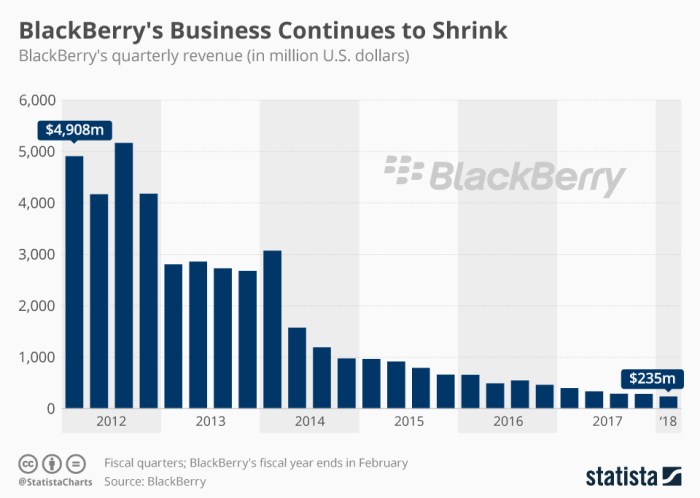
At the height of its success, Blackberry was a force to be reckoned with, boasting a strong financial profile that rivaled its competitors. The company’s impressive revenue streams, coupled with its strategic financial decisions, played a significant role in its high valuation.Blackberry’s peak revenue stream can be broken down into two main categories: hardware sales and service contracts. In 2011, the company reported $9.47 billion in revenue, with hardware sales accounting for $6.7 billion (71% of total revenue) and service contracts generating $2.77 billion (29% of total revenue).| Revenue Streams (2011) | Percentage of Total Revenue || — | — || Hardware Sales | 71% ($6.7 billion) || Service Contracts | 29% ($2.77 billion) |On the hardware front, Blackberry’s iconic smartphones were the primary driver of revenue.
The company’s QWERTY keyboard and secure email capabilities made it a favorite among business users, generating significant revenue from hardware sales. The service contracts, on the other hand, provided a steady stream of recurring revenue, as users subscribed to Blackberry’s service plans, which included data, voice, and messaging services.Now let’s dive into some key financial indicators that highlight Blackberry’s growth during its peak:
Gross Margin
The gross margin is a critical financial metric that measures a company’s profitability on a per-unit basis. In 2011, Blackberry’s gross margin was 42.6%, meaning that for every $100 in revenue, the company kept $42.60 as profit. This is a result of the company’s focus on producing high-quality hardware, which was priced at a premium, allowing for a significant margin.| Year | Gross Margin | Percentage Change from Previous Year || — | — | — || 2009 | 41.9% | – || 2010 | 42.3% | 1.2% || 2011 | 42.6% | 0.7% |
Net Profit Margin
The net profit margin, on the other hand, measures a company’s profitability on a total revenue basis, including all expenses. In 2011, Blackberry’s net profit margin was 11.4%, down from 14.1% in 2010 but still a respectable figure, indicating a healthy bottom line.| Year | Net Profit Margin | Percentage Change from Previous Year || — | — | — || 2009 | 13.2% | – || 2010 | 14.1% | 6.4% || 2011 | 11.4% | -19.1% |
Return on Equity (ROE)
The return on equity (ROE) measures a company’s profitability in relation to shareholder equity. In 2011, Blackberry’s ROE was 28.6%, indicating a strong return on shareholder investment. This is a result of the company’s ability to retain earnings and invest them back into the business.| Year | Return on Equity (ROE) | Percentage Change from Previous Year || — | — | — || 2009 | 22.1% | – || 2010 | 25.6% | 15.8% || 2011 | 28.6% | 11.7% |
Return on Assets (ROA)
The return on assets (ROA) measures a company’s profitability in relation to its total assets. In 2011, Blackberry’s ROA was 12.1%, indicating a moderate return on assets.| Year | Return on Assets (ROA) | Percentage Change from Previous Year || — | — | — || 2009 | 10.3% | – || 2010 | 11.5% | 11.5% || 2011 | 12.1% | 5.2% |The strategic financial decisions that enabled Blackberry to maintain such a high valuation for an extended period include:
Debt Management
Blackberry maintained a relatively low debt-to-equity ratio, ensuring that it had sufficient flexibility to invest in growth initiatives.
Cash Flow Strategies
The company’s focus on generating strong cash flows enabled it to invest in research and development, as well as expand its operations.
Capital Allocation
Blackberry’s capital allocation strategy prioritized growth over dividends, allowing the company to reinvest earnings back into the business.
FAQ Corner
What was the significance of the Pearl (8100) in Blackberry’s history?
The Pearl (8100) was a game-changer for Blackberry, offering a sleek design, improved functionality, and a user-friendly interface that helped propel the company to new heights of success. Its unique features, market reception, and sales figures made it a standout device in its era.
How did Blackberry’s messaging service contribute to its user engagement and retention?
Blackberry’s messaging service was a major draw for users, offering a robust and secure platform that enabled seamless communication and collaboration. Its key features, such as push email and instant messaging, helped Blackberry users stay connected and productive, driving user adoption rates and retention.
What design decisions contributed to Blackberry’s keyboard layout?
Blackberry’s keyboard layout was designed with ergonomics and tactile feedback in mind. The company’s focus on usability and user experience helped create a loyal following among users, who appreciated the comfort and precision of the Blackberry keyboard.
How did celebrity endorsements and product sponsorships reinforce Blackberry’s luxury image?
Celebrity endorsements and product sponsorships played a significant role in reinforcing Blackberry’s luxury image, targeting high-end clientele and solidifying the brand’s reputation as a premium product.
What were the key financial indicators of Blackberry’s growth during its peak?
During its peak, Blackberry’s revenue streams were dominated by sales from hardware and service contracts. The company’s gross margin, net profit margins, return on equity (ROE), and return on assets (ROA) were all indicative of its strong financial performance.
