Net worth of white family vs black family – The net worth of a white family versus a black family is a staggering contrast, a stark reminder of the historic and systemic injustices that have plagued the United States for centuries. From the Reconstruction Era to the present day, the wealth gap between white and black families has been a persistent and deeply ingrained issue. In this article, we will delve into the historical context, socioeconomic factors, education and skill development, financial habits, and institutional barriers that have contributed to this disparity.
The significance of understanding this issue cannot be overstated. By examining the complex web of factors that have led to this wealth gap, we can better understand the ways in which systemic racism and inequality have been perpetuated. This knowledge is crucial in developing effective strategies for addressing and dismantling these injustices, and ultimately, building a more equitable society.
The Significance of Racial Disparities in Net Worth: A Historical Context
The United States has a long-standing history of racial wealth disparities that have been passed down through generations. These disparities can be attributed to systemic injustices and policies that have favored white families over black families. Despite significant progress, the racial wealth gap remains a pressing issue today.In this section, we will explore three significant historical events that have contributed to racial wealth disparities in the United States.
The 1868 Reconstruction Era: Failed Promises of Reparations
During the Reconstruction Era, the 14th Amendment to the US Constitution granted citizenship to former slaves, and the Freedmen’s Bureau was established to provide assistance to newly freed slaves. Although these efforts were instrumental in providing temporary relief, they ultimately failed to address the deep-rooted issues of racism and economic inequality.The Freedmen’s Bureau provided financial assistance, education, and job training to former slaves, but it was severely underfunded and lacked political support.
The promise of 40 acres and a mule for former slaves, which was a provision in the Freedmen’s Bureau Act, was never fully implemented, leaving many black families without access to land or economic resources.This failure to provide reparations for slavery has had long-term consequences for black families, who were already disadvantaged by the institution of slavery. The lack of economic resources and property ownership has contributed to the persistence of racial wealth disparities.
The 1968 Fair Housing Act: Limited Impact on Property Ownership
The Fair Housing Act of 1968 prohibited discriminatory practices in the sale, rental, and financing of housing based on race, color, national origin, or sex. While this landmark legislation was a significant step towards correcting historical injustices, its impact on property ownership rates for white and black families has been limited.Prior to the Fair Housing Act, racial covenants and redlining practices had restricted black families’ access to homeownership.
The Fair Housing Act aimed to address these issues by prohibiting discriminatory practices in the real estate industry.However, the Act’s impact was limited by the fact that it only prohibited overt forms of discrimination, such as refusal to sell or rent property to black families. It did not address the systemic issues of racism and economic inequality that had led to the persistence of racial wealth disparities.Furthermore, the Act did not provide any specific remedies or incentives for black families to purchase homes.
As a result, property ownership rates for black families continued to lag behind those of white families, exacerbating the racial wealth gap.
Legacy of Slavery and Jim Crow Laws
The legacy of slavery and Jim Crow laws has had a profound impact on the economic well-being of black families. The institution of slavery deprived black families of their labor, land, and resources, setting them back centuries in economic development.Jim Crow laws, which were enacted in the late 19th and early 20th centuries, further restricted black families’ access to education, voting rights, and economic opportunities.
These laws institutionalized racism and maintained the racial hierarchy that had been established during the era of slavery.The cumulative effect of these historical events has been a profound impact on the economic well-being of black families, perpetuating a cycle of poverty and disadvantage that has been passed down through generations.
Socioeconomic Factors Influencing Net Worth Variation
The socioeconomic landscape of the United States is a complex tapestry of disparities, woven from the threads of occupation, homeownership, and access to healthcare. These factors have a profound impact on the net worth of families, particularly in terms of the differences between white and black families. Let’s dive into the details.
Occupations and Earning Potential
When it comes to occupation, a significant disparity exists between white and black families in the United States. This is reflected in the types of jobs held, as well as the earning potential and career advancement opportunities available. According to data from the U.S. Bureau of Labor Statistics, in 2020, the median earnings for white men were $60,714, compared to $41,714 for black men.
- Black men are disproportionately represented in lower-paying occupations such as laborers, janitors, and maintenance workers.
- White men, on the other hand, are more likely to be employed in higher-paying occupations such as managers, executives, and professionals.
- The median hourly earnings for Black men and women were $20.45 and $18.93 respectively, compared to $23.57 and $23.11 for White men and women respectively.
This disparity is not only reflected in earnings but also in career advancement opportunities. A study by the Economic Policy Institute found that white men are more likely to be promoted to management positions, while black men and women are more likely to be stuck in lower-paying, entry-level positions.
Homeownership Rates
Homeownership is a key indicator of economic stability and wealth-building. However, a significant disparity exists between white and black families in the United States in terms of homeownership rates. According to data from the U.S. Census Bureau, in 2020, the homeownership rate for white families was 74.5%, compared to 41.8% for black families.
- The median value of owner-occupied housing units for white households was $234,600, compared to $143,200 for black households.
- The median mortgage payment for white households was $1,434, compared to $1,054 for black households.
- The homeownership rate for black households has been declining since the 2000s, while the homeownership rate for white households has remained relatively stable.
This disparity in homeownership rates is a result of a range of factors, including discriminatory lending practices, lack of access to credit, and limited housing options.
Health Insurance and Healthcare Access
Access to healthcare is a critical determinant of economic stability and net worth. However, black families in the United States face significant barriers in terms of health insurance and healthcare access. According to data from the U.S. Census Bureau, in 2020, the uninsured rate for black families was 14.4%, compared to 7.9% for white families.
- The median annual healthcare expenditure for black households was $13,419, compared to $10,439 for white households.
- The out-of-pocket medical expenses for black households were $3,451, compared to $2,439 for white households.
- The black-white disparity in health insurance and healthcare access is a result of a range of factors, including lack of access to employer-sponsored coverage, limited access to Medicaid, and discriminatory practices in the healthcare industry.
In conclusion, the socioeconomic factors influencing net worth variation between white and black families in the United States are complex and far-reaching. Understanding these factors is critical to developing effective policies and programs aimed at reducing the wealth gap and promoting economic stability for all families.In the words of Dr. Martin Luther King Jr., “Life’s most persistent and urgent question is: What are you doing for others?” As we work to address the disparities in socioeconomic factors, we must also recognize the importance of collective action and community support in building a more equitable society for all.
Education and Skill Development as Determinants of Net Worth
+copy.png?w=700 "The Homeownership Gap between Black and White Families in the United ...")
In the United States, education is often touted as the great equalizer. It’s a promise that, if we just work hard and attend the right schools, we can climb the socioeconomic ladder and achieve a life of financial security. But what happens when that promise is broken for entire communities? For black families, the education system has long been a source of frustration and disappointment.
From segregation to police brutality, systemic racism has consistently stood in the way of equal access to quality education. And it’s exactly this kind of unequal access that has perpetuated the net worth gap between white and black families.
The Privileges of Private Education
In the United States, there are numerous elite private schools that cater exclusively to affluent white families. These schools offer the highest quality education, top-notch facilities, and unparalleled resources. Students who attend these schools are more likely to go on to attend top universities, land high-paying jobs, and build wealth over time. Some of the most elite private schools in the country include Phillips Exeter, Deerfield, and Andover.
These schools have acceptance rates as low as 10%, making them even more exclusive than Ivy League universities. By contrast, public schools in predominantly black neighborhoods often lack the resources and support to compete with these private institutions.
- The median household income for families who attend elite private schools is over $250,000.
- These families are more likely to own their own homes, with a median homeownership rate of 70%.
The School-to-Prison Pipeline and its Effect on Black Youth
But what about black youths who don’t have the luxury of attending elite private schools? The school-to-prison pipeline is a phenomenon that funnels African American students from underfunded public schools into the juvenile justice system. This is often due to harsh disciplinary policies, outdated curricula, and a lack of access to quality teachers. As a result, black students are more likely to face suspension, expulsion, and arrest.
| Suspension Rates | Expulsion Rates |
|---|---|
| Black students: 15% | Black students: 3% |
| White students: 5% | White students: 1% |
Higher Education and Increased Earning Potential
But even after accounting for discriminatory education systems, black families still struggle to accumulate wealth. One major factor is the correlation between higher education levels and increased earning potential. According to the Bureau of Labor Statistics, workers with a bachelor’s degree earn a median salary of over $60,000 per year, compared to $25,000 for those with only a high school diploma.
And yet, black families are less likely to attend college, with a higher education attainment rate of just 25%.
“Education is the key to unlocking opportunities, but in our society, that key is often denied to people of color.”
Financial Habits and Savings Practices Among White and Black Families
When it comes to managing their finances, white and black families often have different approaches. One key aspect to consider is the design and common financial goals that guide their savings strategies. Understanding the nuances of these differences is essential in bridging the wealth gap between these two communities.White families tend to prioritize saving for long-term goals such as retirement, paying off mortgages, and investing in the stock market.
They often adopt a disciplined approach to financial planning, creating budgets, and tracking their expenses. A study conducted by the Federal Reserve in 2020 found that 45% of white households had a savings account, compared to 34% of black households. The median savings account balance for white households was $20,000, whereas it was $8,000 for black households.Black families, on the other hand, tend to focus on short-term financial goals such as paying off debt, building an emergency fund, and saving for education expenses.
They often face unique challenges, including limited access to financial resources, higher debt loads, and lower income levels. According to the same Federal Reserve study, 71% of black households had high-interest debt, compared to 52% of white households.
Common Financial Goals Among White Families
White families often prioritize saving for:
Retirement
76% of white families have a retirement account, compared to 53% of black families.
“Saving for retirement is a top financial priority for many white families, with 76% having a retirement account, compared to 53% of black families.”
Paying off mortgages
63% of white families own their homes compared to 42% of black families.
Investing in the stock market
61% of white families have invested in stocks, compared to 38% of black families.These financial goals are often achieved through a combination of disciplined financial planning, education, and access to financial resources.
Financial Products and Services More Widely Available to White Families
White families often have better access to financial products and services that contribute to their higher net worth, including:
Higher credit limits
White families tend to have higher credit limits, allowing them to access more credit and invest in assets.
Lower interest rates
White families often have better access to low-interest loans and credit cards, reducing their debt burden.
Investment opportunities
White families are more likely to invest in stocks, bonds, and real estate, generating higher returns on their investments.
Financial Literacy Programs and Education
Financial literacy programs and education can play a crucial role in bridging the wealth gap between white and black families. By teaching people about budgeting, saving, and investing, these programs can empower individuals to make informed financial decisions and achieve their long-term goals.
Ways to Improve Financial Literacy
To improve financial literacy, consider the following:
Take a financial literacy course
Many non-profit organizations and financial institutions offer free or low-cost financial literacy courses.
Read personal finance books
Books like ‘The Total Money Makeover’ and ‘Your Money or Your Life’ offer practical advice on managing finances.
Seek professional advice
Financial advisors can provide personalized guidance on managing finances and achieving long-term goals.
Use online resources
Websites like NerdWallet and The Balance offer a wealth of information on personal finance and investing.By promoting financial literacy and education, we can empower individuals to make informed financial decisions and bridge the wealth gap between white and black families.
Institutional Barriers to Building Wealth
When we think about the disparities in net worth between white and black families, it’s easy to point fingers at individual behavior or personal choices. But the truth is, there are deep-seated institutional barriers that have been systematically designed to limit access to resources and opportunities for black families. These barriers are rooted in systemic racism and implicit bias, and they have a profound impact on the net worth of black families.
The Role of Systemic Racism and Implicit Bias
Systemic racism refers to the ways in which institutions and policies perpetuate racial inequality. Implicit bias, on the other hand, refers to the unconscious stereotypes and prejudices that individuals hold. Both of these factors play a significant role in limiting access to resources and opportunities for black families. For example, research has shown that black borrowers are more likely to be denied mortgages or face higher interest rates than white borrowers with similar credit scores.
This can lead to a lifetime of reduced wealth-creating opportunities.
Government Policies and Programs: Exacerbating Racial Wealth Disparities, Net worth of white family vs black family
Some government policies and programs may seem designed to help low-income families, but they can often have the opposite effect. For instance, the 1990s-era welfare reform in the US introduced time limits on benefits, making it difficult for families to access the support they need. Additionally, programs like “Work First” and “Family Cap” policies were designed to encourage people to work and have fewer children, but they often end up pushing families further into poverty.
These policies have disproportionately affected black families, exacerbating racial wealth disparities.
Predatory Lending Practices: Financial Exploitation of Black Families
Predatory lending practices are one of the most insidious forms of financial exploitation. These practices involve offering loan products with interest rates that are exorbitantly high, often targeting low-income and black communities. For example, a 2019 report by the National Consumer Law Center found that black borrowers were 5.8 times more likely to be targeted by predatory lenders than white borrowers.
As a result, black families often end up in debt spirals, with interest rates that make it difficult to pay off the principal balance.
Real-Life Examples: The Harsh Reality of Predatory Lending
Meet Sarah, a single mother of two living in a low-income neighborhood in Chicago. She was struggling to make ends meet, so she turned to a payday lender to cover an unexpected medical bill. She borrowed $1,000 at an annual interest rate of 300%. That $1,000 turned into $3,000 within a year, and Sarah found herself trapped in a cycle of debt.
Stories like Sarah’s are all too common in low-income and black communities, where predatory lenders prey on vulnerable individuals.
The Impact on Net Worth
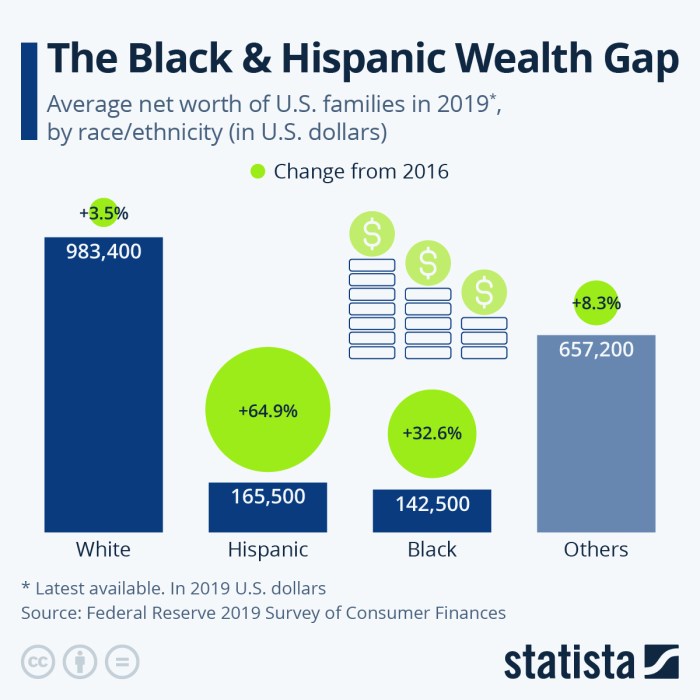
The cumulative effect of these institutional barriers is a devastating reduction in net worth for black families. According to a 2020 report by Credit Karma, the median net worth of a black family in the US is just $17,600, compared to $147,000 for white families. This is a staggering disparity, especially when you consider that black families have been systematically denied access to resources and opportunities for centuries.
A Call to Action
So, what can be done to address these institutional barriers? We must first acknowledge the role of systemic racism and implicit bias in perpetuating these disparities. We must then work to dismantle these systems and policies that perpetuate inequality. This requires a collective effort to raise awareness, build community, and advocate for policy change. By working together, we can begin to close the wealth gap and build a more equitable society for all.
Strategies for Closing the Net Worth Gap: Net Worth Of White Family Vs Black Family

As we’ve explored the harsh reality of the racial net worth gap, it’s clear that closing the divide won’t happen overnight. But, with the right strategies, mindset, and community support, we can start to bridge the gap and ensure a brighter financial future for black families. Let’s dive into some effective initiatives, innovative financial products, and community-based organizations that are working towards this goal.
Empowering Wealth-Building Initiatives
The National Minority Federal Credit Union (NMFCU) is a shining example of a program that’s making a real difference. Launched in 1998, the credit union aims to promote financial inclusion and economic empowerment among minority communities. With a focus on education, savings, and asset-building, NMFCU has provided over $1 billion in loans to members, with a delinquency rate of less than 1%.
By leveraging technology, building partnerships, and fostering a sense of community, NMFCU has created a model for wealth-building that can be replicated across the country.
Innovative Financial Products
Gather ‘Round, a financial cooperative in New York, has developed an innovative savings program that’s specifically designed to help black families build wealth. The program, called “Save to Own,” provides low-interest savings loans and peer-to-peer lending opportunities, allowing members to save and borrow money from fellow community members. With an emphasis on education and financial literacy, Gather ‘Round has helped over 10,000 members save over $25 million.
This approach not only promotes financial inclusion but also fosters a sense of community and collective responsibility.
Community-Based Organizations
The African American Women’s Wealth Alliance (AAWWA) is a powerful example of a community-based organization that’s dedicated to empowering black women and girls to take control of their financial futures. Founded in 2018, AAWWA offers financial education and coaching, business training, and networking opportunities. With a focus on building wealth, AAWWA has helped over 500 members save an average of $5,000 each.
By leveraging the collective power of community, AAWWA is creating a ripple effect of financial empowerment that’s transforming lives and breaking down barriers to wealth.
Technology-Driven Solutions
The use of mobile apps, online platforms, and other digital tools is revolutionizing the way black families access financial services and build wealth. Apps like Empower and MoneyLion are providing affordable and accessible financial services, such as checking accounts, credit monitoring, and budgeting tools. Online platforms like Prosper and LendingClub are offering peer-to-peer lending opportunities, allowing individuals to borrow and save money from fellow community members.
By harnessing the power of technology, these innovations are expanding access to financial services and empowering black families to take control of their financial futures.
The Role of Community-Based Cooperatives
Cooperatives, like the Federation of Southern Cooperatives (FSC), are community-owned businesses that operate for the benefit of their members. FSC, founded in 1967, provides financial services, education, and technical assistance to its members, who are largely small farmers and entrepreneurs. By pooling resources and expertise, cooperatives like FSC are creating a network of financial support that’s tailored to the needs of black families.
This approach to financial inclusion is not only empowering but also fosters a sense of community and collective ownership.
Questions and Answers
Q: What are some historical events that have contributed to the wealth gap between white and black families?
A: The Reconstruction Era, the 1968 Fair Housing Act, and the legacy of slavery and segregation have all played significant roles in perpetuating the wealth gap.
Q: What is the significance of education and skill development in bridging the wealth gap?
A: Higher education levels and skills have been shown to increase earning potential and contribute to a higher net worth. However, systemic barriers and biases have historically limited access to quality education and job opportunities for black families.
Q: How do institutional barriers affect the ability of black families to build wealth?
A: Predatory lending practices, financial exploitation, and systemic racism have all contributed to the wealth gap by limiting access to resources and opportunities for black families.
Q: What are some strategies for closing the wealth gap?
A: Innovative financial products, financial literacy programs, and community-based organizations and cooperatives can help bridge the wealth gap by promoting financial inclusion and addressing systemic inequalities.
